
Views: 0 Author: Site Editor Publish Time: 2026-10-30 Origin: Site


Harvesting forage is fundamentally a race against unpredictable weather windows. Heavy spring rains saturate fields. Consequently, standing crops quickly tangle and lodge against the muddy topsoil. Traditional equipment often chokes under these grueling conditions. What should be a straightforward harvest turns into a frustrating mechanical battle against plugged machinery. You stare through the tractor cab window at a flattened mat of alfalfa, knowing every pass will likely end in a clogged implement and wasted hours.
Older sickle models easily plug and drag in these heavy crop conditions. Transitioning to a modern hay mower equipped with rotary technology offers the ultimate engineering solution for challenging weather. Its streamlined design slices through dense, moisture-laden crops without hesitation. This technical breakdown explores the fluid dynamics and mechanical advantages of rotary implements in saturated fields. Furthermore, we will detail how to optimize your field setup—covering cutting height, ground speed, and safety—while highlighting the internal transmission components that dictate machine reliability.
Clog-Free Architecture: Rotary systems eliminate stationary rock guards. This open design prevents heavy, wet biomass from bottlenecking and halting your harvest.
High-Speed Aerodynamic Lift: Fast-spinning discs create a massive updraft. This suction physically lifts lodged crops off the soil milliseconds before severing them.
Drivetrain Durability: Saturated crops exert immense mechanical strain. Robustly engineered transmissions ensure consistent power delivery without thermal breakdown.
Optimized Field Speeds: Operators can maintain higher forward momentum in adverse conditions without sacrificing yield quality.
Strategic Adjustments: Proper skid shoe elevation accelerates the drying process and protects the driveline from hidden field debris.
Harvesting forage under ideal, dry conditions requires minimal mechanical intervention. Agricultural realities, however, involve narrow weather windows, sudden rainfall, and compromised soils. To understand why modern rotary technology dominates these environments, we must examine the physical properties of saturated crops alongside the mechanical limitations of legacy harvesting equipment.
When heavy rain impacts a mature field, plant structure changes dramatically. Added water weight causes stems to bend, tangle, and mat against the soil surface. Agronomists refer to this stressful condition as lodging.
Lodged crops present a severe aerodynamic and mechanical hurdle. Flattened and intertwined stems refuse to feed cleanly into standard cutting mechanisms. Specifically, high moisture content increases the tensile strength of plant fibers. This demands significantly more shearing force to sever the stem. If the implement cannot lift the tangled mat and apply sufficient torque, the inevitable result is ragged stubble, stripped leaves, and degraded nutritional quality.
For decades, the reciprocating sickle bar served as the industry standard. Its mechanical design is fundamentally unsuited for heavy, damp environments. These machines operate using a scissor-like action where a serrated knife slides through stationary rock guards. In dry, upright grass, this works perfectly. In lodged crops, it becomes a severe liability.
Damp material builds up rapidly on stationary fingers. Reciprocating knives completely lack the aerodynamic suction required to lift a tangled mass. Consequently, the crop simply drags across the bar. Operators are forced to constantly disengage the PTO, reverse the tractor, and manually clear mud-caked alfalfa. This vicious cycle destroys field efficiency and accelerates wear on drive components.
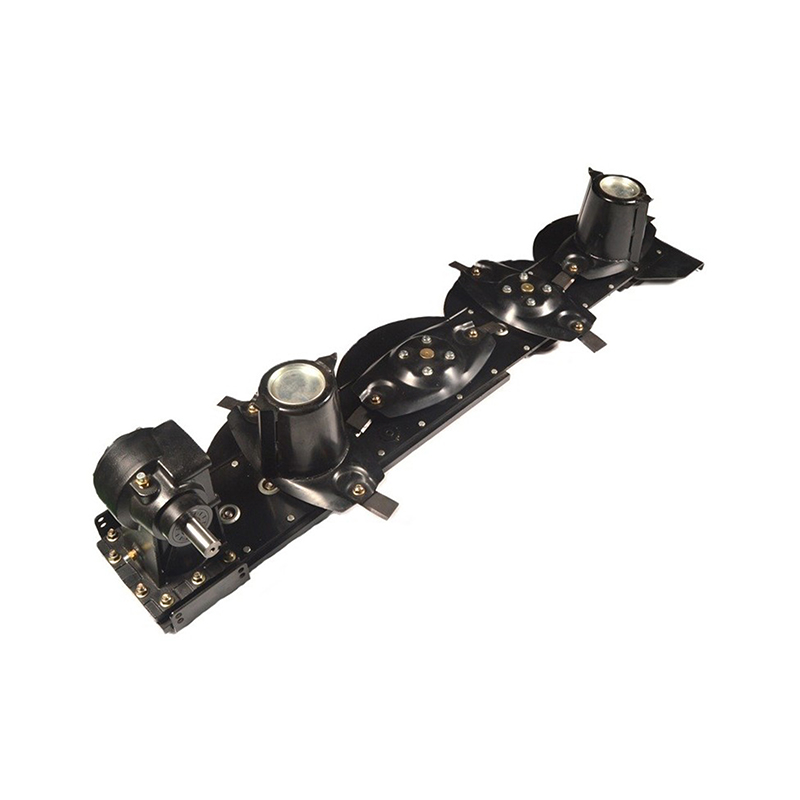
The transition to rotary technology revolutionized wet-weather harvesting. Modern equipment addresses the physical challenges of saturated forage through two primary mechanical advantages: an unobstructed flow path and engineered aerodynamic lift.
The defining feature of this machinery is its streamlined profile. Instead of a reciprocating knife passing through stationary guards, it utilizes independent, low-profile metal discs. These are mounted atop a fully enclosed gear casing.
Because no stationary guards protrude from the front of the cutterbar, there is no bottleneck for plants to catch on. As the machine advances through a tangled field, severed material flows seamlessly over the top. Continuous rotary motion actively feeds the plant backward, allowing the implement to operate completely clog-free.
The second critical advantage lies in fluid dynamics. Each rotating disc features two or more free-swinging knives. These components are precisely angled and rotate at extreme velocities, frequently achieving tip speeds exceeding 180 miles per hour.
As they spin, they act like high-speed fans generating a powerful suction effect. Just before the tractor passes over a flattened patch of forage, this updraft pulls tangled stems upright. The blades then slice cleanly through the taut fibers. This dynamic lifting action ensures uniform stubble height and prevents tractor tires from rolling over valuable tonnage.
Feature | Traditional Sickle Bar | Modern Rotary Cutterbar |
|---|---|---|
Clogging Risk in Wet Forage | Extremely High | Virtually Zero |
Aerodynamic Lift | None | High Suction Updraft |
Optimal Ground Speed | 2 to 4 mph | 5 to 10 mph |
Maintenance in Mud | Frequent manual clearing | Self-cleaning flow path |
Not all agricultural implements are engineered to the same industrial standard. Processing dense, heavy forage requires machinery built with heavy-duty components capable of withstanding massive torque loads and harsh environmental realities.
The main bar serves as the structural foundation of the machine. In damp environments, the ground is frequently soft and uneven. A premium design features a smooth underbelly that glides over challenging terrain without bulldozing mud into the canopy.
Operators typically evaluate fully welded versus modular construction. Modular systems are highly preferred by commercial operators. Each rotating disc is housed in its own separate gear station. If a catastrophic failure occurs due to striking a hidden rock, the operator can replace a single module directly in the field. This drastically reduces costly downtime.
Severing moisture-laden hay requires substantially more horsepower than processing dry grass. The increased mass of water-logged plants places immense continuous resistance against the spinning discs.
To maintain extreme tip speeds, the machine relies entirely on its power transmission system. This makes the disc mower gearbox the absolute most critical component. A high-quality transmission efficiently transfers power from the tractor Power Take-Off to the cutting mechanisms without slipping. Conversely, an under-engineered component will suffer internal gear shearing or bearing failure under heavy shock loads. Industry-leading designs utilize nodular cast iron housings and precision-forged bevel gears to handle these extreme torque requirements.
Muddy fields are notorious for hiding hazards. Rushing water washes away topsoil, exposing thick branches and stones. Striking a rock at high velocity will instantly shatter a knife.
Modern equipment features quick-change systems that utilize a specialized pry tool to compress the retention spring. This allows the operator to safely swap out damaged mower blades in seconds. Eliminating the need to wrestle with rusted bolts in the mud is indispensable when fighting a tight weather window.
Even with top-tier equipment, operator technique dictates the success of a wet-weather harvest. The delicate relationship between forward travel speed and the quality of the cut must be carefully managed.
A common debate among agricultural professionals is how fast one can drive through saturated forage. Under ideal conditions, modern implements comfortably operate at ground speeds of 7 to 10 mph. In contrast, speed must be modulated when dealing with lodged crops.
While the machine itself will not plug at higher speeds, driving too fast overwhelms the aerodynamic lift. This results in uncut streaks. Empirical field data suggests reducing ground speed to 5 to 7 mph in extremely dense patches. This gives the cutting elements sufficient time to lift the lodged crop, sever it cleanly, and clear the material backward.
While forward travel should be adjusted based on crop density, the tractor PTO RPM must remain absolutely constant. A frequent mistake inexperienced operators make in muddy fields is throttling down the engine to slow their forward momentum.
Throttling down reduces the PTO RPM, which directly lowers the rotational speed of the driveline. When velocity drops, crucial aerodynamic suction is lost. The machine will begin to tear the plant rather than slice it. To slow down properly, operators must shift to a lower transmission gear while keeping the engine throttle wide open.
Setting the correct elevation is a vital agronomic and mechanical decision, particularly when the topsoil is compromised by rain.
In a dry pasture, operators might lower the machine to maximize yield. In a saturated field, cutting too low is a costly error. Soft soil is easily disturbed by the intense suction of spinning discs.
If set too low, the updraft pulls dirt directly into the forage canopy. This contaminates the feed with high levels of ash, severely degrading nutritional value for livestock. Furthermore, dragging the metal housing through abrasive mud rapidly dulls cutting edges and increases the draft load on the tractor.
To prevent soil contamination, the implement must be properly elevated. This is achieved by adjusting the heavy-duty skid shoes located beneath the main housing or by utilizing the tractor hydraulic top link to alter the pitch angle.
Agricultural engineers generally recommend a stubble height of 3 to 4 inches for muddy environments. Elevating the skid shoes ensures the machine floats over soft ground. This protects the plant crown for rapid regrowth while avoiding hidden stones.
Slicing through damp forage cleanly is only the first phase. The ultimate goal is to dry the crop to a safe moisture level for baling or chopping before the next rainstorm arrives.
A standard rotary implement cuts the plant and lets it fall to the ground in a wide swath. While sufficient for arid climates, humid conditions demand mechanical intervention to accelerate moisture evaporation. A conditioner attachment mounted directly behind the cutting zone physically alters the plant stem to allow trapped water to escape rapidly.
The choice of conditioning mechanism depends heavily on the specific crop being harvested. Impeller conditioners utilize V-shaped steel tines that rotate at high speeds, rubbing the crop against a metal hood. This abrasive action strips the waxy outer cuticle from the plant, making it highly effective for grass varieties.
In contrast, roller conditioners consist of two interlocking rubber or steel cylinders that crush the crop. This crimping action cracks open the thick stems of leafy crops like alfalfa. It allows the wet inner core to dry at the exact same rate as the fragile leaves.
Recent ag-tech market analyses reveal a significant year-over-year increase in demand for high-torque rotary harvesting systems, particularly in regions prone to erratic spring rainfall. Climate volatility is actively shrinking optimal harvest windows. Consequently, farm operators are abandoning legacy reciprocating technology. Instead, they are investing heavily in modular rotary systems equipped with over-engineered drivetrains.
This shift is driven by the commercial imperative to secure high-protein forage before rot sets in. Equipment manufacturers are responding by utilizing advanced metallurgy to handle the immense shock loads of processing wet, dense biomass. The integration of nodular cast iron gearboxes and precision-forged internals ensures that modern farms remain profitable despite increasingly unpredictable weather patterns.
Investing in new agricultural machinery requires a strict evaluation of mechanical specifications. Standard implements often lack the structural integrity required to operate efficiently in adverse weather. When selecting a machine specifically for these climates, buyers must prioritize components designed for high-torque loads and rapid field serviceability.
High-Clearance and Modular Architecture
Look for models equipped with adjustable, heavy-duty skid shoes. These components protect the underside from abrasive mud. Prioritize modular construction featuring individually sealed gear stations. If one station is damaged by a rock pushed up by mud, the operator can replace that specific segment without disassembling the entire machine.
Premium Power Transmission Specs
Cutting heavy, moisture-laden hay requires substantially more torque than dry grass. The driveline must handle continuous strain without thermal breakdown. Look for specifications similar to the KLF-GC series standard: high-strength nodular cast iron housings and precision-forged bevel gears. Cast iron offers superior structural stability and heat dissipation compared to lighter aluminum materials.
Toolless Maintenance Systems
In soft soils, tractor tires often push debris to the surface. Operating with dull edges causes tearing rather than slicing, drastically increasing drivetrain load. Prioritize models that offer quick-change blade mechanisms, allowing an operator to safely swap out damaged parts directly in the field.
While wet, tangled fields are a nightmare for older equipment, modern rotary technology turns a potentially ruined schedule into a successful harvest. The open architecture prevents frustrating plugging in dense canopies. Simultaneously, the aerodynamic updraft ensures every stalk is lifted and sliced cleanly.
By relying on the high-speed action of the discs and the brute strength of a well-engineered transmission system, farmers can power through the toughest environmental conditions. If you are upgrading your agricultural fleet, explore the robust transmission solutions at Kadiva. Their KLF-GC series and heavy-duty gearboxes are engineered specifically to withstand the brutal demands of wet-weather harvesting. Equip your machinery with components that refuse to quit when the weather turns.
Mechanically speaking, yes. A modern rotary implement lacks the stationary rock guards found on traditional sickle models. Because there are no guards for the wet material to snag on, the machine can slice through saturated crops in the middle of a rainstorm without plugging. However, from an agronomic perspective, cutting while it is raining is generally not recommended unless you are harvesting the crop for wet silage. If the goal is dry forage, the cut crop will simply lie on the wet ground and rapidly spoil.
Leaving streaks or ragged patches of uncut crop is a common issue when operating in dense, damp fields. The most frequent cause of streaking is driving the tractor too fast for the conditions while allowing the PTO RPM to drop. The discs rely on high rotational speed to generate the aerodynamic lift needed to pull flattened crops upward. Dull cutting edges or an incorrect tilt angle will also cause the machine to ride over flattened crops without properly engaging them.
Regardless of how wet or lodged the crop is, you must maintain the manufacturer-recommended PTO speed, which is typically 540 or 1000 RPM depending on your tractor and implement. Dropping below this speed drastically reduces blade tip velocity and aerodynamic suction. Always use your transmission gears to reduce ground speed, never the engine throttle.
Preventing mud build-up relies entirely on proper pitch and height adjustment. Ensure your heavy-duty skid shoes are set to maintain a minimum cutting height of 3 to 4 inches. Adjust the hydraulic top link so the deck remains relatively flat or tilted slightly upward, rather than pitched down into the soil. This prevents the machine from bulldozing topsoil and allows the self-cleaning aerodynamic flow to clear debris.
Proper lubrication is the single most critical factor in preventing catastrophic mechanical failure. When processing heavy, damp crops, the driveline components are subjected to maximum load, generating significant internal heat. You should completely drain and replace the oil before the first cut of the year to remove winter condensation. During the season, perform a visual inspection daily for leaks, and verify the fluid level using the dipstick after every 50 hours of operation.
A standard rotary implement does not inherently dry the internal moisture of the plant faster than a sickle model. Both machines perform the same basic function of severing the stem. It can indirectly aid the initial drying process by leaving a wider, more evenly distributed swath behind the machine. For true acceleration of the drying process in humid climates, the machine must be equipped with a mechanical impeller or roller conditioner.