
Views: 0 Author: Site Editor Publish Time: 2026-09-16 Origin: Site


You are in the peak of fertilizing season. The weather window is slamming shut, and there are still hundreds of acres left to cover. Suddenly, your rig stalls out in the middle of a muddy field. For commercial operations, equipment breakdowns cost far more than just replacement parts; they bleed precious time and decimate potential crop yields. In my years of field engineering, the culprit behind a stalled rig is almost always an undersized or failing transmission hub.
The spreader gearbox is the beating heart of your heavy-duty equipment. It takes the raw rotational energy from a tractor and translates it into the brute mechanical force required to move massive, dense loads of organic material. When it comes to large farm manure spreading, grabbing a standard, off-the-shelf component is a guaranteed recipe for disaster. In this engineering guide, we will break down exactly why torque ratings and precise gear ratios dictate your operational efficiency, machinery lifespan, and ultimately, a profitable harvest.
High Torque is Non-Negotiable: A robust drive unit prevents catastrophic mechanical failure when pushing dense, wet, or frozen materials out of high-capacity hoppers.
Ratios Dictate Agronomic Precision: The correct mathematical gear ratio ensures a consistent spread pattern, which is fundamental for soil health and preventing toxic nutrient runoff.
Drive Architecture Matters: The shift from traditional mechanical PTOs to hydraulic systems fundamentally alters how you control application rates on the fly.
Industrial Specs Over Standard: Upgrading to specialized components with reinforced housings and case-hardened gears drastically reduces maintenance downtime.
Before diving into the mechanical specs, it is crucial to understand where agricultural technology is heading. We are seeing a massive industry shift away from brute-force "dump and drag" methods toward Precision Nutrient Management. Driven by strict environmental regulations regarding phosphorus runoff and the skyrocketing costs of synthetic fertilizers, commercial farms must maximize the agronomic value of organic waste.
Consequently, there is a surging demand for Variable Rate Application (VRA) technologies. Farmers are moving away from fixed-speed mechanical drives and retrofitting their fleets with advanced hydraulic transmissions. This evolution emphasizes the need for highly responsive, variable-speed drive systems that integrate seamlessly with GPS mapping and ISOBUS tractor controls, ensuring every single acre receives the exact nutrient prescription it requires.
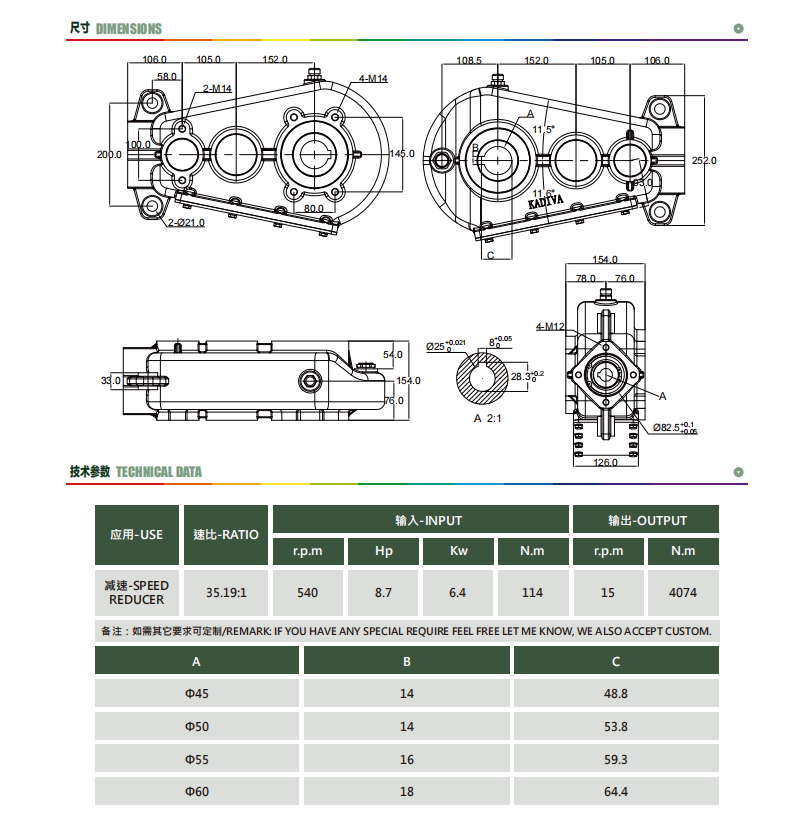
At its core, this central hub acts as a mechanical bridge. It receives high-speed rotational kinetic energy and uses a precise configuration of internal gears to reduce input speed while simultaneously multiplying the twisting force. This converted energy is then routed to the heavy-duty apron chains dragging across the floor, and the rear beaters responsible for fracturing the payload.
There is a massive engineering divide between light-duty implements and the heavy iron required for commercial-scale agriculture. Operators routinely deal with extreme volumetric capacities exceeding 800 to 1,000 bushels. Furthermore, material consistency varies wildly. One day you are spreading liquid dairy slurry; the next, dense, highly abrasive poultry litter. Standard gearboxes simply cannot dissipate the thermal load generated under these conditions, inevitably leading to blown seals and shattered pinions.
In straightforward engineering terms, torque is the measurement of twisting force. While horsepower dictates how fast a machine performs work, torque determines whether the machine can initiate that work in the first place. When operating a commercial manure spreader, torque is the specific pulling power required to overcome the massive static friction of a resting payload and set those steel floor chains into motion.
Imagine a hopper packed to the brim with compacted cattle sludge that has been sitting overnight in freezing temperatures. The resting weight pressing down on the floor chains is immense. A properly rated drive unit is engineered to power through this intense initial resistance without stalling the tractor or twisting the driveline. If a frozen chunk of debris enters the rear beaters, an undersized transmission will attempt to force the rotation, usually resulting in a cracked cast-iron housing. Conversely, a robust transmission works in harmony with safety mechanisms like slip clutches, protecting the expensive internal gearing from destruction.
Gear ratio is the mathematical relationship between the input speed and the output speed. For instance, a ratio of 1:1.5 means that for every full rotation of the input shaft, the output shaft turns one and a half times. This alters the speed to match the precise revolutions required by the rear spinners.
Agronomic science is clear on this: nutrient distribution must be highly uniform. If the internal ratio is incorrect, the rear beaters rotate too slowly, dropping heavy, localized clumps of nitrogen-rich waste that burn crops. Spin them too fast, and you pulverize the material into a fine dust that drifts away in the wind. Correct ratios balance the slow crawl of the floor apron with the violent spinning of the beaters, preventing severe jams and massive driveline strain.
Selecting the right drive architecture fundamentally changes your field operations. While traditional Power Take-Off (PTO) systems rely directly on the tractor's engine via a heavy-duty drive shaft to deliver a constant RPM, hydraulic systems are rapidly becoming the commercial standard.
Hydraulic options offer the distinct advantage of infinitely variable speed control. This allows the operator to adjust the discharge rate directly from the cab, independent of engine RPM. Let us look at a direct comparison:
Feature / Spec | Traditional Mechanical PTO | Hydraulic Drive (e.g., KLF-H400 Series) |
|---|---|---|
Speed Control | Fixed (tied to tractor RPM) | Infinitely variable via cab controls |
Shock Load Resistance | Relies on shear pins/slip clutches | Excellent (hydraulic relief valves absorb shock) |
Output Torque | Limited by PTO shaft strength | High torque output (up to 4000+ Nm) |
Precision Ag Compatibility | Poor / Manual adjustment only | Seamless GPS & ISOBUS integration |
Choosing the correct component requires moving away from guesswork and matching the continuous load rating to the volumetric capacity of your fertilizer machine. Do not pair a massive 250 HP tractor with a low-rated transmission unit. When a sudden load spike occurs, the tractor will effortlessly overpower the internal mechanics, instantly blowing oil seals or twisting the input shaft.
For commercial rigs holding upwards of 1,000 bushels, you need industrial-grade solutions like the KLF-H400 series. These heavy-duty models utilize oversized tapered roller bearings and reinforced output shafts specifically designed to shoulder continuous radial and axial loads without deflecting. Always ensure your drive system is rated to safely absorb the maximum output of the towing vehicle.
The longevity of any mechanical transmission is directly tied to preventative maintenance. Neglect is the fastest route to a catastrophic breakdown. Operators should visually inspect the housing daily for oil leaks around the input and output seals. Check the backlash on the gears; excessive play means internal wear is accelerating.
Thermal management is absolutely critical. As internal teeth mesh under extreme pressure, they generate incredible heat. Utilizing the manufacturer-recommended gear oil—usually an 80W-90 API GL-5 or a synthetic equivalent—is mandatory. This fluid creates a microscopic protective film, reducing metal-on-metal friction and pulling heat away from the critical load-bearing surfaces of your agricultural spreader. If the cast housing becomes too hot to touch with a bare hand, or if you hear a high-pitched whining noise, pull the unit for an immediate overhaul.
Successful large-scale organic fertilizing relies entirely on the hidden, hardworking mechanics of your power transmission. Without a reliable drive, your expensive equipment is reduced to a standstill, crippling your seasonal productivity. By prioritizing robust pulling power, selecting the correct mathematical ratio, and embracing modern hydraulic architectures, you ensure an agronomically sound application across every acre.
Do not wait for a catastrophic failure in the middle of a muddy field. If your rig is struggling with heavy loads or you are looking to upgrade to precision variable-rate application, it is time to invest in specialized components. Explore high-performance solutions like the KLF-H400 and find the exact high torque gearbox tailored for your commercial operation at Kadiva today.
An incorrect ratio forces the rear beaters to spin either too fast or too slow relative to the speed of the floor apron. This mismatch results in uneven application, leaving heavy, toxic clumps of manure in your field, and places immense mechanical strain on the entire driveline, ultimately harming your final crop yields.
If you operate a large-capacity rig (generally over 400 bushels), frequently haul wet, heavy dairy slurry, or work in muddy, freezing conditions, upgrading to a heavy-duty unit is strictly required. Standard models simply cannot handle the extreme starting inertia of these dense loads without tearing themselves apart.
Absolutely not. The transmission must precisely match the tractor's PTO output speed. Mismatching these parameters will drastically alter the internal operating speeds, leading to highly inefficient performance, severe overheating, and eventual catastrophic mechanical failure.
Choose a mechanical PTO for straightforward, budget-friendly operations where application rates do not need constant adjustment. However, if you require precision agriculture integration, variable rate application (VRA), or frequent adjustments based on field conditions, a hydraulic drive is the superior choice due to its infinitely variable speed control and shock absorption capabilities.
Overheating is typically caused by three factors: operating with low or degraded gear oil, pushing the gearbox beyond its rated torque capacity with excessively dense loads, or internal bearing failure causing excessive friction. Regularly checking oil levels and ensuring your gearbox size matches your hopper capacity will prevent thermal breakdown.
As a best practice in the engineering field, you should drain and replace the gear oil after the first 50 hours of use on a brand-new unit to flush out any metallic break-in particles. Thereafter, the fluid should be changed annually or every 250 to 300 hours of operation, strictly adhering to your specific manufacturer's maintenance guidelines.