
Views: 0 Author: Site Editor Publish Time: 2026-09-25 Origin: Site


Are uneven crop yields eating into your margins? Every season, operators face the headache of spreading fertilizer or manure evenly across rough terrain. A mismatched transmission system ruins this balance. You end up wasting expensive resources and severely hurting your harvest potential.
The central power-transfer mechanism is the heartbeat of any application implement. Get this drive system right, and you eliminate costly downtime. Get it wrong, and you will find yourself replacing shear pins in a muddy field. This guide breaks down the engineering realities of fluid-driven versus mechanical power take-off systems. We will help you match the exact configuration to your daily field conditions.
Core Function: The transmission unit dictates the operational speed, breakaway torque, and material spread pattern of your equipment.
Mechanical Power: Traditional direct-drive systems deliver unmatched, brute force. They are highly effective for moving heavy, dense livestock waste but require consistent engine RPMs.
Fluid Precision: Fluid-powered setups offer infinite variable speed control. This enables highly precise material applications completely independent of the tractor's ground speed.
Selection Criteria: Your optimal choice depends on the tractor’s fluid flow capacity (GPM), material density, and field topography.
Smart Modernization: Retrofitting an older mechanical implement with a modern fluid drive is a practical, cost-effective way to upgrade your fleet without buying new machinery.
To truly understand equipment performance, we must look at the core components. Think of the transmission unit as the backbone of your operation. It transfers power from the towing vehicle to active mechanisms like apron chains, horizontal beaters, and vertical spinners. Without a reliable agricultural transmission gearbox, you are essentially just dragging dead weight across a field. It converts high-speed rotational energy—typically 540 or 1000 RPM—into the massive torque needed to move tons of compacted material.
Inconsistent power delivery inevitably causes uneven distribution. In practical terms? You get nutrient burn in certain zones and severe deficiencies in others. A properly matched, high-quality drive unit prevents sudden material jamming. It absorbs brutal shock loads when beaters strike foreign objects, ultimately minimizing premature wear on the tractor's driveline.
Historically, the industry relied on simple ground-driven systems where wheel traction powered the chains. However, modern farming demands higher capacities and tighter controls. This operational shift drove the transition toward highly engineered mechanical and fluid-based power systems.
The Power Take-Off drive remains a staple in heavy-duty machinery. Operating through a direct, unyielding mechanical connection, a physical steel driveshaft links the tractor's rear stub to the implement. Once the clutch is engaged, rotational force hits the spreading mechanisms with almost zero lag.
Mechanical systems excel in brute-force applications. Because the power transfer is purely physical, energy loss through heat or friction is minimal. This makes a traditional PTO gearbox exceptionally capable of powering large implements loaded with dense, wet, or frozen materials. Imagine firing up your rig on a freezing morning with a load of compacted dairy manure. The mechanical drive provides the unyielding breakaway torque needed to shatter that load.
This traditional design has been field-tested for decades. Diagnosing a failure is straightforward, often requiring just a quick visual check of slip clutches. It does not rely on internal pump capacity, making it universally compatible with older utility tractors.
However, this raw power comes with a rigid RPM dependency. The spreader's speed is tied directly to engine revolutions. If you slow down to navigate a deep rut, the spread rate drops simultaneously. Exposed driveshafts also pose significant safety risks, demanding strict adherence to shielding protocols. Finally, sharp turns at headlands put extreme stress on U-joints, causing violent driveline chatter that can shatter internal gears.
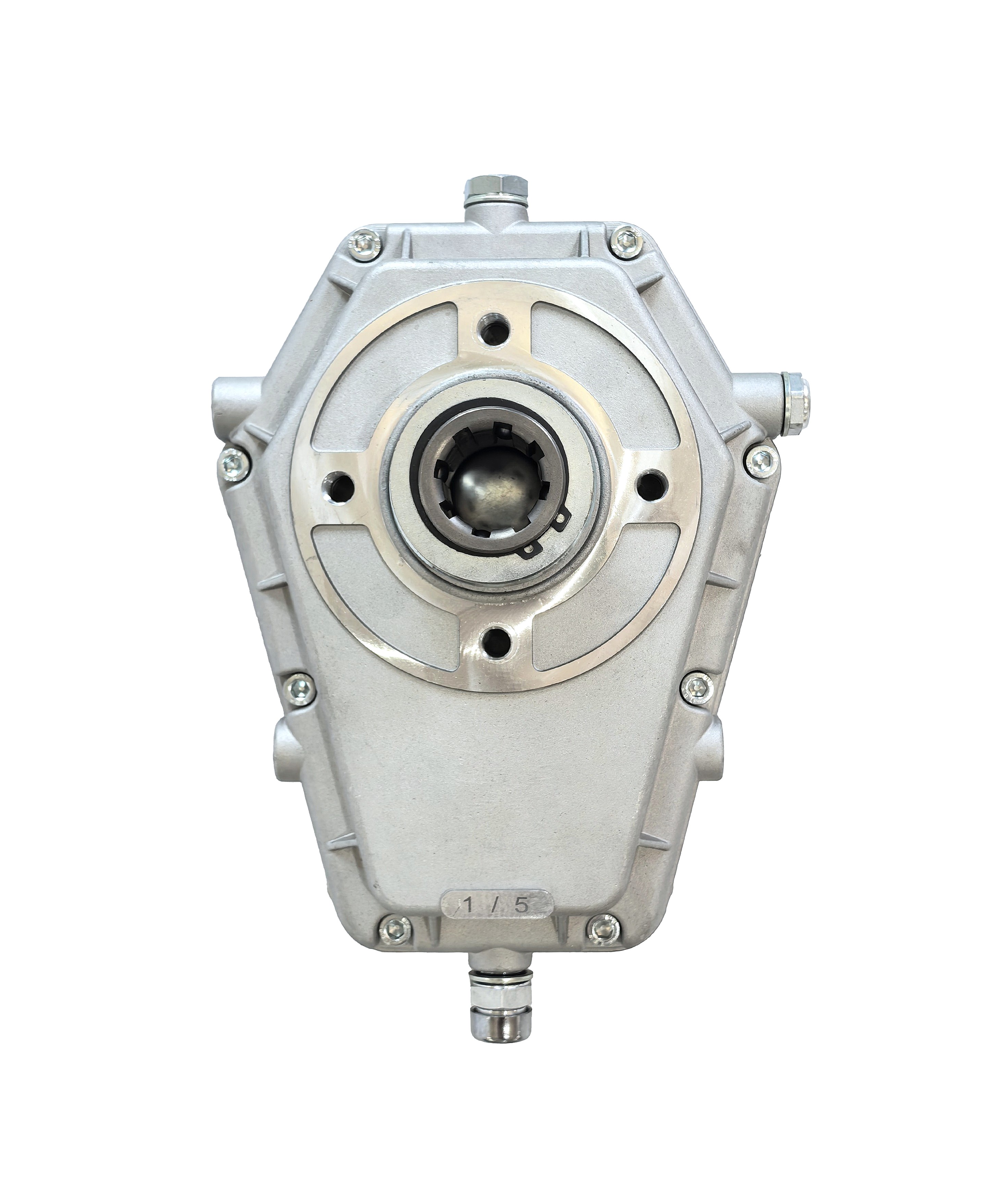
Precision agriculture is no longer just a buzzword; it is an economic necessity. A modern hydraulic spreader gearbox utilizes the tractor’s internal pump. Pressurized fluid routes through heavy-duty hoses to a motor mounted directly on the implement. The fluid's flow and pressure turn the motor, driving the spreading mechanisms with incredibly smooth power.
The biggest advantage here is infinite adjustability. You can finely tune apron chain speeds independently of ground speed. This precision is absolutely crucial when distributing expensive granular fertilizers, where every wasted pound eats into your bottom line. High-grade units often feature customizable gear ratios (like 1:1 or 1:1.5) and output torque capacities exceeding 1,200 Nm, ensuring they can handle dense loads while maintaining exact metering.
Maneuverability improves drastically. Without a spinning driveshaft between vehicles, you can execute tight 90-degree turns without driveline binding. Many configurations even allow you to reverse the fluid flow from the cab. Reversing the apron chain is a massive advantage when clearing severe jams, saving you from dangerous manual labor.
Despite these benefits, fluid systems are demanding. They require a towing vehicle that can deliver adequate sustained flow (GPM) and pressure (PSI). If your pump falls short, the implement will stall under load. Furthermore, fluid systems hate contamination. A single grain of dirt entering a coupler can destroy internal seals, and continuous heavy use on hot days can lead to fluid overheating.
Looking at recent agricultural sector data, there is a definitive shift toward Variable Rate Application (VRA) technology. Driven by strict environmental regulations regarding nutrient runoff and highly volatile global fertilizer prices, farmers can no longer afford to "guess and spread." Industry insights show a massive surge in demand for fluid-driven transmission systems over the past five years.
Interestingly, market reports indicate that rather than buying entirely new implements—which requires massive capital investment—commercial operators are investing heavily in fluid-drive retrofits. This strategic move allows farms to integrate GPS-guided precision into their existing fleets. By upgrading the power transmission, operators optimize chemical usage and maximize crop yields while maintaining strict budget controls.
When evaluating power transmission methods, you must rely on empirical data rather than marketing fluff. The debate comes down to mechanical efficiency, application precision, and maintenance cycles. The following table summarizes the core operational differences.
Feature / Metric | Mechanical (PTO) Drive | Fluid (Hydraulic) Drive |
|---|---|---|
Power Source | Direct mechanical link to engine | Pressurized fluid flow (GPM) & pressure (PSI) |
Speed Control | Fixed ratio; depends on engine RPM | Infinitely variable; independent of RPM |
Mechanical Efficiency | High (minimal power loss) | Moderate (some power lost to heat) |
Application Precision | Standard (best for bulk waste) | High (ideal for variable-rate application) |
Driveline Flexibility | Low (sharp turns cause binding) | High (flexible hoses allow sharp turns) |
Primary Vulnerability | Shear pins, U-joints, driveline angles | Blown hoses, seal leaks, contamination |
From an engineering standpoint, a direct mechanical link offers superior raw efficiency. Transferring rotational energy through a solid steel shaft results in very little power loss. Fluid systems, while highly effective, experience inherent energy losses due to fluid friction and pressure drops. However, what fluid power lacks in brute mechanical transfer, it makes up for in operational flexibility.
Field durability is a frequent debate. Proponents of mechanical drives love their simplicity. Routine maintenance means greasing U-joints and swapping broken shear pins—a quick fix in the dirt. Fluid systems eliminate U-joint greasing but introduce the risk of blown high-pressure hoses and leaking O-rings. Repairing a high-pressure leak in the field is complex and requires specialized crimping tools.
Before tractor-powered systems took over, ground-driven mechanisms were the standard. The physical rotation of the implement’s wheels engaged a chain system to operate the beaters. As you pulled the unit forward, tire traction turned the mechanism.
While still manufactured, they are largely relegated to small hobby farms or ATV-towed setups. Their fatal flaw is wheel traction. In muddy, wet, or icy conditions, the tires simply slide. The spreading mechanism stops completely. For reliable commercial operations, upgrading to a powered transmission is non-negotiable.
Selecting the optimal drive system requires looking hard at your daily operational parameters. Consider these critical factors before investing to ensure the technology actually matches your reality.
First, evaluate your tractor's capabilities. Check your fluid flow rating. A heavy-duty motor may require 15 to 20 GPM to operate efficiently under load. If you run an older utility tractor producing only 8 GPM, a fluid drive will overheat the oil. In that scenario, a mechanical setup is the only reliable way to power your spreader machine.
Material density matters immensely. Heavy, clumpy, or frozen dairy waste creates massive resistance. This demands the brute mechanical force of a PTO-driven manure spreader. Conversely, dry, granular fertilizer flows easily but requires exact metering. The variable precision of a fluid system is perfectly suited for these high-value materials.
Look at your field layout. Fields with tight corners, irregular boundaries, or narrow gates require frequent sharp turns. A mechanical driveline chatters under sharp angles, risking severe gear damage. Fluid drives use flexible hoses, letting you navigate tight headlands without cutting the power.
Even the toughest equipment eventually surrenders to agricultural environments—acidic waste, constant vibration, and brutal shock loads. Knowing when to replace your transmission unit prevents catastrophic failures during critical application windows.
Do not wait for a complete breakdown. Excessive grinding or whining noises point to worn gear teeth or failing bearings. If the cast-iron housing is too hot to touch, internal friction is destroying the unit. Persistent oil weeping around the input seals means internal pressures have compromised the housing, and lubrication failure is imminent.
Converting an aging mechanical implement to a modern fluid system is straightforward for experienced technicians. You remove the original driveshaft and slip clutch assembly. Next, fabricate a custom bracket to align a new hydraulic motor with the input shaft. Connect the motor using a flexible jaw coupling, route high-pressure hoses safely along the drawbar, and install an in-line pressure relief valve to protect against spikes.
Choosing the right drive system profoundly impacts your maintenance schedules, daily efficiency, and ultimate crop yields. Traditional mechanical systems deliver the raw power necessary for heavy waste management and remain incredibly reliable for older tractor fleets. Modern fluid systems, however, offer unmatched precision, safety, and variable control—making them mandatory for high-value fertilizer distribution and precision agriculture.
Your final decision must align with your tractor's exact hydraulic specifications, your daily material types, and your field topography. Do not settle for inferior aftermarket parts. If you are ready to upgrade your agricultural machinery for maximum efficiency and longevity, explore the high-performance transmission solutions at Kadiva to find the exact gearbox engineered for your specific field demands.
Yes. Many farmers opt for a low-cost fluid retrofit. It involves removing the original mechanical driveline and installing a fluid motor coupled to a compatible transmission unit. However, you must meticulously ensure your tractor has sufficient fluid flow (GPM) and pressure (PSI) to power the new motor effectively without overheating.
A mechanical drive requires simpler, familiar maintenance like greasing U-joints and checking gear oil. A fluid-driven system eliminates driveline angle wear and U-joint greasing but demands incredibly strict fluid maintenance. You must keep all couplers immaculately clean and monitor hoses for degradation to prevent seal leaks.
Typically, yes. Because a fluid drive allows you to adjust the apron or spinner speed completely independently of your tractor's engine RPM or ground speed, it offers superior precision. This variable-rate control is critical for granular fertilizers where perfectly even distribution directly impacts crop health.
If your tractor cannot supply the required fluid flow, the motor will lack the power to operate effectively under load. The spreading mechanisms will turn too slowly or stall, resulting in severe material clumping and jamming. If your tractor lacks capacity, a mechanical direct-drive is the reliable choice.
Yes. Top-tier manufacturers offer custom-engineered drives or universal replacement units. These heavy-duty components can be engineered with exact gear ratios and custom mounting footprints, allowing you to breathe new life into older implements without buying a completely new machine.
Cold weather severely impacts hydraulic systems because the fluid thickens, leading to sluggish operation and potential pump cavitation until the oil reaches operating temperature. A PTO mechanical drive is unaffected by fluid viscosity, delivering instant, unyielding breakaway torque to shatter frozen materials immediately upon engagement.
Absolutely. In fact, a hydraulic spreader gearbox is the ideal choice for VRA. Because the motor speed is controlled by fluid flow rather than engine RPM, it integrates seamlessly with GPS-guided electronic controllers. The system can automatically adjust the apron chain or spinner speed on the go, applying precise nutrient amounts based on specific soil zone data.