
Views: 0 Author: Site Editor Publish Time: 2026-10-21 Origin: Site


Are you struggling to match cutting efficiency with your tractor's actual capability? Balancing the physical size of an agricultural implement with the power of your machinery is a critical challenge for any forage producer. A disc-based cutting system solves this dilemma. It offers specific configurations tailored to different operational scales. By utilizing a precise array of spinning blades, these machines slice through heavy, wet forage where traditional sickle bars would choke and stall.
To make an informed purchasing decision, operators must first understand the fundamental mechanics at play. Unlike rotary cutters that rely on a single massive blade, this equipment leverages a specialized modular design. The core mechanism consists of a low-profile cutterbar housing a gear-driven or shaft-driven driveline. Mounted on top of this bar are multiple rotating discs, typically oval or circular, equipped with free-swinging steel blades attached to their outer edges.
When the Power Take-Off, or PTO, is engaged, energy transfers through the driveline. This causes these components to spin at exceptionally high velocities. We are often looking at speeds exceeding 2,500 to 3,000 Revolutions Per Minute. This intense rotational speed generates a significant aerodynamic updraft. Picture a dense patch of alfalfa drenched in heavy morning dew. The updraft physically lifts the lodged or flattened plant stems, allowing the free-swinging blades to shear through them cleanly.
Distributing kinetic energy across an array of smaller cutting heads maintains high tip speeds across the entire width of the cutterbar. This continuous, overlapping action prevents clogs and ensures a rapid processing rate. It allows the machinery to glide through adverse field conditions without tearing the delicate, nutrient-rich leaves of the crop.
The primary factor dictating the efficiency of your hay harvesting operation is the physical width of your equipment. Manufacturers design different configurations to meet specific acreage and horsepower constraints. Understanding these standard size categories will help you pinpoint the exact disc mower model that fits your daily workflow.
An entry-level setup typically features four or five cutting heads. Engineers design these compact units specifically for hobby farmers, equestrian property managers, and small-scale hay operations managing limited acreage. A four-disc unit yields an effective cutting width of roughly 5 to 5.5 feet. Adding a fifth disc extends that reach to approximately 6.5 feet.
Because of their shorter cutterbars, these compact implements generate significantly less leverage against the tractor's three-point hitch. You can safely lift and transport them using smaller utility tractors without creating a severe tipping hazard. Their nimble footprint makes them highly maneuverable. They are perfect for irregularly shaped pastures, orchards, or fields dotted with obstacles like trees and fencing.
Stepping up to mid-sized commercial farms and independent hay producers, the six to seven-disc layout becomes the industry standard. This category strikes an optimal balance between aggressive field efficiency and manageable machinery requirements. A six-disc unit typically covers 7.5 to 8 feet of ground per pass. A seven-disc version pushes the cutting width closer to 9.5 feet.
Operating at these widths allows farmers to cover significantly more ground per hour. This drastically reduces fuel consumption and labor costs. Navigating standard rectangular fields becomes a rapid process. Yet, the equipment remains capable of folding into a vertical transport position for safe travel on narrow rural roads.
At the absolute top end of the spectrum sit the heavy-duty commercial machines carrying eight, nine, or even more cutting heads. Designed for custom harvesting operations and massive dairy farms, an eight-disc setup yields a cutting width of 10 to 10.5 feet. Pushing into nine-disc territory often exceeds 11.5 feet of continuous shearing action.
The physical demands placed on the tractor at this scale are immense. Heavy, high-mass tractors are mandatory. They are not just needed to drive the massive cutterbar through dense crop canopies, but to act as a vital counterweight. Attempting to lift an eight-disc implement on a standard three-point hitch with a lightweight tractor will cause a violent lateral weight shift. Consequently, these larger setups frequently utilize semi-mounted or fully trailed chassis to distribute the burden safely.
Relying solely on manufacturer brochures can sometimes be misleading. Overall transport width and effective cutting width represent two entirely different metrics. When evaluating specifications, you need to project how a specific disc count translates to actual grass cut per pass.
As a reliable field estimate, each individual cutting head on a standard agricultural cutterbar covers approximately 1.3 to 1.5 feet of ground. If you multiply the number of heads by 1.4 feet, you will find a highly accurate estimated cutting width. For instance, a six-disc setup yields roughly 8.4 feet of effective coverage.
It is critical to note that these spinning components are not spaced end-to-end. If they were, the machine would leave frustrating streaks of uncut grass between each head. Internal gears are precisely timed so the rotational paths of the blades overlap by a few inches. One head spins clockwise while its neighbor spins counter-clockwise. This creates a synchronized, self-cleaning shearing action. This precise overlap guarantees a flawless cut, though it means adding a new head does not add its full physical diameter to the machine's total width.
Recent agricultural sector analyses reveal a distinct shift in how producers select their forage harvesting equipment. Driven by increasingly unpredictable weather patterns and shrinking harvest windows, there is a pronounced industry-wide migration toward wider cutting widths and higher disc counts. Commercial operations that previously relied on six-disc systems are now upgrading to eight or nine-disc trailed configurations to maximize labor efficiency.
Furthermore, the data shows a rising demand for modular driveline designs that simplify field maintenance. As farm labor becomes scarcer and more expensive, the ability to clear a 50-acre field in a single afternoon rather than two days has shifted high-capacity mowers from a luxury to a financial necessity. This trend is closely tethered to the evolution of modern utility tractors, which now offer higher average PTO horsepower and greater hydraulic capacities than models produced a decade ago. Advancements in metallurgy and suspension systems have also made wider cutterbars more adept at contouring to uneven terrain, mitigating the scalping issues that once plagued oversized equipment.
A common and costly error in agricultural procurement is mismatching the implement to the tractor. The size of your cutterbar dictates both the power required to spin the blades through dense vegetation and the physical mass the tractor must stabilize on uneven terrain. Always differentiate between Engine HP and PTO HP. Implements draw power exclusively from the PTO, which is inherently lower due to transmission friction losses.
To make selection easier, refer to the following baseline matching guide. This table outlines the minimum requirements to maintain the crucial 3,000 RPM blade speed in thick crops without bogging down your machine.
Disc Count | Estimated Cutting Width | Minimum PTO HP Required | Ideal Farm Application |
|---|---|---|---|
4 Discs | 5.0 - 5.5 feet | 30 - 35 HP | Hobby farms, tight orchards |
5 Discs | 6.5 - 7.0 feet | 40 - 45 HP | Small-scale hay operations |
6 Discs | 7.5 - 8.5 feet | 50 - 60 HP | Mid-size independent producers |
7 Discs | 9.0 - 9.5 feet | 60 - 70 HP | Large independent producers |
8+ Discs | 10.0+ feet | 75 - 85+ HP | Commercial & custom harvesting |
Beyond pure power, tractor weight is paramount here. A standard five-disc implement can weigh over 1,000 lbs. When that heavy cantilevered weight extends six feet to your right, your tractor must have adequate rear track width and front-end ballast to prevent the opposite tire from lifting off the soil. If you attempt to force an oversized cutterbar onto an underpowered tractor, the PTO RPM will plummet the moment you hit a dense patch of wet forage. This results in ragged, torn grass rather than clean cuts, ultimately stalling the machine and damaging the crop's regrowth potential.
Selecting the correct machinery requires a clear assessment of your specific field conditions and end goals. While determining the right size is crucial, you must also verify that a disc-based system is actually the most appropriate tool compared to other available technology.
The distinction between a forage mower and a rotary cutter, often called a bush hog, lies in their cutting mechanism and primary application. Forage equipment utilizes razor-sharp blades to slice cleanly through grasses and legumes, preserving the delicate, nutrient-dense leaves. Rotary cutters feature a single, heavy, dull blade designed to tear and shatter thick stalks, saplings, and brush. If your goal is high-quality livestock feed, you need a clean slice. If your goal is reclaiming overgrown land, you need the shattering force of a rotary cutter.
Alternatively, you might consider a mower conditioner, commonly known as a discbine. This equipment utilizes the exact same cutting technology but incorporates heavy conditioning rollers immediately behind the cutterbar. As the crop is cut, it passes through these rollers, which crimp the plant stems to accelerate moisture loss. For farmers in humid climates, this drastically reduces drying time. However, these units are substantially heavier, demand significantly more horsepower, and carry a much higher upfront cost. In arid climates where hay cures rapidly under the sun, a standard non-conditioning implement is often the smarter financial choice.
The operational efficiency of a harvester is not solely dictated by its width. The internal power transmission system serves as the true heart of the machine. Regardless of the size of the cutterbar, the entire system will fail if the power delivery from the tractor is inefficient, vibrating, or prone to overheating. As engineers, we look directly at the gearbox specifications to determine reliability.
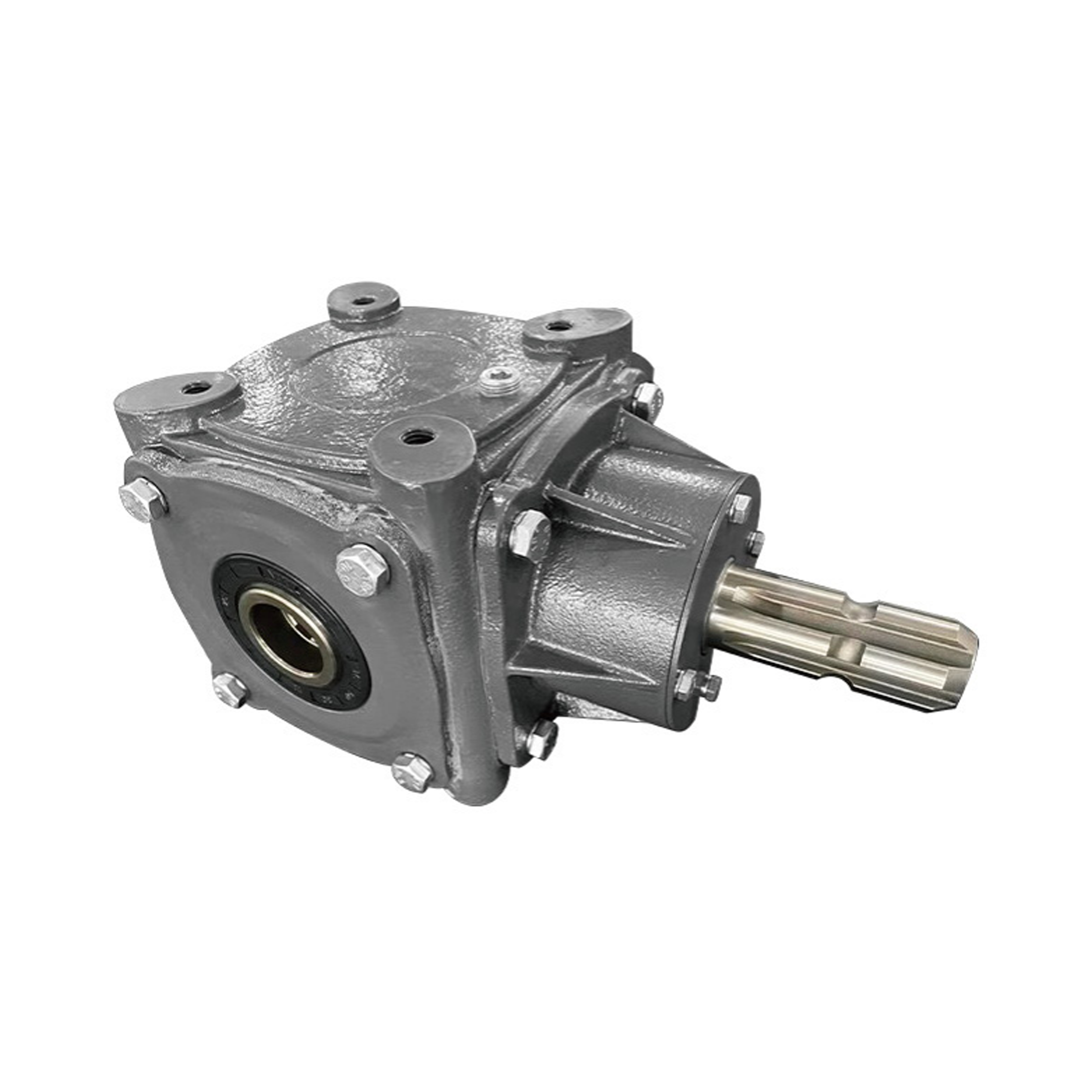
Energy transfer begins at the tractor's PTO stub, traveling through a telescoping shaft equipped with universal joints. This shaft connects directly to the implement's primary gearbox. This component takes the standard 540 or 1000 RPM input from the tractor, steps up the speed, and redirects the kinetic energy at a 90-degree angle down into the cutterbar.
Operating in dense, wet, or lodged crops generates immense mechanical resistance. The internal bevel gears, bearings, and seals must be engineered to exact tolerances to withstand this torque. For example, industrial-grade components like the Kadiva KLF-GC165 series gearboxes are designed with high-strength nodular cast iron housings and precision-forged alloy steel gears. These units typically handle input powers ranging from 40 to 80 horsepower and feature optimized gear ratios to maintain consistent cutterbar RPM under heavy load.
If the primary gear system fails due to poor metallurgy or lack of lubrication, the entire machine seizes. Sourcing a precision-engineered gearbox is non-negotiable for long-term operational stability. High-grade components reduce vibration, lower operating temperatures, and ensure that rotational energy is distributed evenly, keeping all cutting heads perfectly synchronized.
Agricultural equipment operates in brutal environments characterized by dust, abrasive debris, and hidden field obstacles. Protecting your investment requires a strict, proactive maintenance routine. The longevity of your mower discs and internal drive components depends entirely on daily care.
Before entering the field, operators should perform a tactile inspection of the cutting components. Check the metal caps, or turtles, for excessive wear or stress fractures. Ensure the blades are sharp and pivot freely on their mounting bolts. Centrifugal force relies on these blades swinging outward. If they are seized by rust or wrapped twine, the machine will vibrate violently, tearing the grass and burning extra diesel.
Friction is the primary enemy of high-speed machinery. The cutterbar, which houses the internal spur gears, must be filled with the precise volume and weight of gear oil specified by the manufacturer. Overfilling causes seals to blow due to thermal expansion, while underfilling leads to catastrophic gear failure. Always drain and inspect the oil annually, looking closely for metallic shavings that indicate premature internal wear.
Even with careful driving, striking hidden rocks or stumps is inevitable. Modern equipment features built-in shear hubs beneath each cutting head. If a blade strikes an immovable object, you will hear a sudden snap as the specific hub shears intentionally, disconnecting that head from the main driveline. This brilliant safety mechanism prevents the shockwave from shattering the expensive internal gears. Keep spare shear hubs in your tractor cab to minimize downtime and get back to cutting within minutes.
Choosing the right forage harvesting implement depends entirely on the size of your fields, your desired cutting width, and the realistic capabilities of your tractor. A compact four to five-disc setup is the perfect match for hobby farms and smaller utility tractors, offering agility and ease of use. Conversely, commercial operations managing hundreds of acres will benefit immensely from the rapid clearing power of eight to nine-disc trailed configurations, provided they have the heavy-duty horsepower to support them.
Always verify your tractor's PTO rating and physical weight before finalizing a purchase. By matching your machinery correctly, adhering to strict lubrication schedules, and investing in high-quality replacement drive components, you will ensure a clean cut, rapid crop regrowth, and years of reliable service in the field.
If you are experiencing driveline vibrations or looking to upgrade your harvesting equipment's power transmission, selecting the right internal components is critical. We encourage you to evaluate your current setup and explore professional-grade solutions. Visit Kadiva to find precision-engineered gearboxes and drive components perfectly matched to your agricultural machinery needs.
Generally, no. While the physical three-point connection might fit, a six-disc setup usually requires a minimum of 50 to 60 PTO horsepower to maintain the correct blade tip speed in thick crops. Running a larger implement on an underpowered tractor will bog down the engine, overheat the transmission, and pose a severe tipping hazard due to the heavy cantilevered weight extending to the side of the machine.
During standard operation, the cutting heads spin at incredibly high velocities, typically ranging between 2,500 and 3,200 RPM. This extreme speed is necessary to create a strong aerodynamic updraft, which lifts lodged or flattened grasses off the ground so the blades can slice the stems cleanly rather than passing over them.
Modern agricultural engineering accounts for unseen field hazards. High-quality implements are equipped with shear hubs, sometimes called shock hubs or roll pins, located beneath each individual cutting head. If an immovable object is struck, the hub is designed to break intentionally. This isolates the impact, stopping the individual head while protecting the main cutterbar and internal gears from catastrophic damage.
Blade replacement frequency depends entirely on the acreage harvested and specific soil conditions. Sandy or rocky terrain will dull steel rapidly, whereas clean, established pastures allow for extended lifespan. Most blades are dual-sided. Operators typically unbolt and flip them to the fresh edge halfway through the cutting season. It is a standard best practice to install a completely new set of blades at the beginning of every hay season to ensure maximum fuel efficiency and crop yield.
Yes, the tilt angle is critical. Adjusting the top link of your tractor's three-point hitch changes the pitch of the cutterbar. A slight downward tilt allows for a closer cut, which is ideal for smooth pastures. However, tilting it too far forward increases the risk of scalping the soil and drawing dirt into the forage, which degrades feed quality and accelerates blade wear.
Uncut streaks usually point to a mechanical timing issue or severely worn components. The rotational paths of adjacent discs are designed to overlap. If a blade is missing, bent, or if the internal gears have slipped out of timing, this overlap is compromised. Additionally, operating at too low of a PTO RPM reduces the aerodynamic updraft, causing the grass to fold under the blades rather than being cut cleanly.