
Views: 0 Author: Site Editor Publish Time: 2026-09-30 Origin: Site


For farm operators and dedicated food plot enthusiasts, time equals money. Picture this: you are managing a sprawling 50-acre pasture. The spring planting window is rapidly closing. The idea of dumping seed and fertilizer into a single hopper to finish the field in one swift pass sounds incredibly appealing.
However, field reality often clashes with this concept. Seeds and nutrient granules possess drastically different weights, sizes, and aerodynamic profiles. Uniformly distributing them is a massive mechanical headache.
Can it actually be done? Yes. You can execute a dual-application pass with a single machine. But this is not about luck. It relies entirely on the internal engineering, torque capacity, and precise calibration of your spreader gearbox. This guide breaks down the physics of single-pass broadcasting. We will explore operational efficiencies, provide a bulletproof calibration method, and show exactly how the right drivetrain prevents a patchy, ruined field.
A robust drivetrain is the critical component that dictates whether mixed materials spread evenly or separate disastrously.
Variances in seed mass directly alter their "spread ballistics" when they hit the spinning impeller.
Combining field tasks slashes diesel consumption and labor hours. It is highly efficient for large-scale property management.
Continuous internal hopper agitation is mandatory. It prevents dense fertilizer prills from settling beneath lighter seeds.
Never store mixed organic and chemical materials together in the hopper. Hygroscopic fertilizers will aggressively draw moisture and destroy seed viability.
Recent agricultural equipment analyses reveal a massive shift toward multi-functional implements. Why is this happening? Skyrocketing diesel prices and persistent labor shortages are the primary drivers. Farmers can no longer afford the luxury of running a tractor over the same field twice if it can be avoided.
Consequently, the demand for precision-engineered equipment capable of handling dual-material loads has surged. Operators are rapidly ditching basic, ground-driven models. Instead, they are investing in advanced hydraulic and high-torque PTO systems. These upgraded systems offer independent, highly accurate control over mixed materials. This is not just a passing trend. It is the new baseline for profitable, efficient property management.
To know if one implement can handle two distinct materials, we must look under the hood. The drivetrain acts as the central nervous system of any broadcast equipment. It dictates exactly how mechanical power is distributed and utilized.
You might operate a heavy-duty tractor unit. Or perhaps you use a nimble ATV-towed implement. Either way, raw power must become usable rotational energy. The gearbox takes force from the Power Take-Off (PTO) or hydraulic motor and splits it. This kinetic energy drives two main components: the high-speed spinning impeller and the slower, high-torque hopper agitator.
When a single machine acts as both a nutrient applicator and a fertilizer spreader, the drivetrain endures brutal stress. If the internal gears lack durability, the crushing weight of fertilizer combined with seed friction causes micro-fluctuations in speed. Ultimately, these tiny drops lead to a patchy application rate.
Rotational speed (RPM) and torque are your most critical performance metrics. RPM directly dictates the throw width. Higher RPM means the spinner flings material further. Torque is the raw twisting force required to keep the agitator churning through dense, clumped materials.
During a combined application, the drivetrain must supply immense torque. This prevents the agitator from binding up. Simultaneously, it must maintain a perfectly stable RPM so delicate seeds distribute evenly. A sudden drop in RPM instantly narrows your spread pattern. The result? Embarrassing bare strips across your pasture.
Yes, it works. But you cannot simply dump random bags of material into a hopper and expect a golf-course finish. Success requires a strict understanding of basic physics.
Broadcasting relies entirely on centrifugal force. When particles drop onto the impeller, they are violently thrown outward. Their travel distance—their "ballistics"—is determined by mass and aerodynamic profile.
Standard NPK granules are dense, heavy, and spherical. They carry significant momentum and fly far. In contrast, grass seeds are light and fluffy. They catch the wind easily and drop fast. Therefore, even with flawless machinery, heavy fertilizer spreads wider than lightweight seed. You must acknowledge this limitation and adjust your driving overlap.
Vibration causes a phenomenon known as "sifting." As a tractor rumbles over clods, heavy particles sink to the hopper's bottom. Lighter particles vibrate to the top.
To combat this, modern equipment uses continuous internal agitation. When executing mixed seed fertilizer sowing, a robust drivetrain keeps the agitator churning. It folds the materials back into a homogenous blend milliseconds before they drop through the gate. Without this mechanically driven mixing, you would broadcast all your fertilizer in ten minutes, followed by a dense dump of pure seed.
Before committing to a single-pass strategy, weigh the operational efficiencies against the agronomic risks.
Combining tasks effectively cuts tractor time in half. This brings massive commercial value.
Drastic Fuel Savings: Running a heavy diesel engine for one pass instead of two slashes fuel consumption.
Reduced Soil Compaction: Fewer tire passes mean looser topsoil. This promotes vastly superior root growth.
Labor Optimization: Finishing the job in a single afternoon frees up valuable labor hours for other maintenance tasks.
Despite the efficiencies, there are distinct disadvantages. If the seeding machine is poorly calibrated, you will experience "striping." Seed falls densely behind the tractor, while fertilizer flies to the edges. Furthermore, fertilizer burn is a severe risk. Nitrogen salts aggressively draw moisture out of seed coats. If mixed too far in advance, they kill the embryo before it hits the soil.
Relying on guesswork wastes expensive materials. Meticulous calibration is non-negotiable.
Calculate the exact pounds per acre required for both materials. Base this on recent soil tests. Blend the materials thoroughly outside the machine. Use a cement mixer or a clean tarp. Do not simply layer them in the hopper. This ensures the agitator only maintains the blend, rather than fighting to create it.
Set the hopper gate to accommodate the largest particle in your mixture. This is almost always the nutrient granule. If you set the gate too narrow to favor the seed, the fertilizer will bridge and clog.
Because the gate is open wider, material flows out faster. Consequently, you must increase your ground speed. This prevents over-application and chemical soil burn.
Heavy granules fly further than light seed. You must determine your actual, usable spread width. Lay out large blue tarps in a straight line. Drive over them at operational speed while broadcasting.
Inspect the tarps. You will see a sparse pattern of fertilizer and a dense, narrower pattern of seeds in the center. Measure the width of the seed pattern only. This measurement dictates your pass overlap.
Achieving uniform distribution requires material compatibility. If you mix dense prills with fluffy seeds, the spinning disc separates them in mid-air.
The golden rule is to match the physical dimensions and weight of your seed to your fertilizer. When materials share similar properties, centrifugal force affects them equally. They land in the same target zone. If a slight mismatch is unavoidable, rely on the rotational consistency of your drivetrain to minimize separation.
Heavy seeds with smooth, hard coats perform exceptionally well. Winter wheat, oats, rye, and soybeans have enough mass to match standard fertilizers. Conversely, fine fescues and tiny clover seeds are too light. They catch the wind and drop directly behind the tires. For dust-like seeds, a dedicated second pass is highly recommended.
If you constantly battle clogged hoppers or uneven spread patterns, the root issue is likely your mechanical drivetrain. The heart of any reliable broadcast system is the gearbox.
Standard residential spreaders use a flimsy wire agitator. These snap under heavy agricultural loads. This is where an auger gearbox becomes an absolute necessity. It operates at a lower RPM with significantly higher torque. It drives a solid metal auger vertically through the hopper. This relentless churning breaks up clumped material and forces a metered flow down to the spinner.
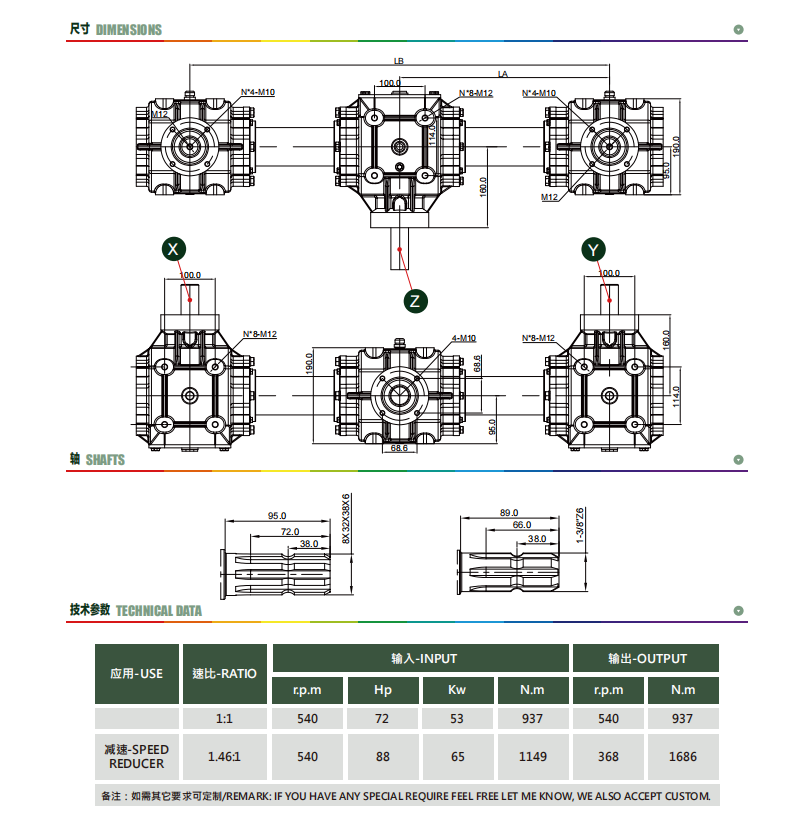
As an engineer evaluating equipment, durability and precise control are paramount. Look for specific technical parameters. For example, professional-grade models like the KLF-190-R3 feature specialized 1:1 gear ratios designed to perfectly balance input power with output torque.
Feature | Standard Light-Duty Gearbox | Heavy-Duty Agricultural Gearbox (e.g., KLF-190-R3) |
|---|---|---|
Housing Material | Stamped Steel / Plastic | Cast Iron (Highly Corrosion-Resistant) |
Agitator Drive | Wire Pin (Prone to snapping) | Solid Helical Auger (High Torque) |
Bearing Type | Unsealed | Fully Sealed (Dust & Chemical Proof) |
Power Source | Ground-driven | PTO or Hydraulic Motor Integration |
Mixed Load Capacity | Low (Prone to bridging and clogging) | High (Maintains continuous uniform flow) |
When selecting an agricultural gearbox, demand fully sealed bearings. Abrasive fertilizer dust destroys unsealed gear teeth in a single season. Cast iron housings are non-negotiable to withstand chemical degradation.
The efficiency gained by single-pass sowing is negated if equipment is poorly maintained. Organic seed dust and chemical fertilizers create a highly corrosive residue.
Nitrogen, phosphorus, and potassium are salts. Mixed with ambient humidity, they form acidic compounds that rapidly oxidize steel. Wash out the hopper, gate mechanisms, and spinner disc immediately after fieldwork. Never leave leftover mix in the hopper; it turns into a rock-hard block. Avoid blasting high-pressure water directly at gearbox seals.
Once dry, locate all Zerk fittings. Apply high-quality, water-resistant agricultural grease. Pump until clean grease purges from the bearing edges. Check the internal oil level. If the oil appears milky, water has breached the seals, and the fluid must be replaced.
Mixed seed and fertilizer sowing is a highly efficient strategy. It saves time, slashes fuel costs, and minimizes soil compaction. While differing material weights present a physical challenge, it is an obstacle you can engineer your way around.
Success comes down to understanding material ballistics, performing the tarp test, and relying on a durable drivetrain. A high-quality gearbox provides the consistent torque and stable RPM necessary to keep the mixture homogenous.
If your current setup causes uneven crop emergence or broken agitator pins, it is time for an upgrade. A precision-engineered drivetrain pays for itself in saved fertilizer and higher crop yields. Explore the robust selection of high-torque gearboxes at Kadiva (https://www.hz-kadiva.com) to find the exact match for your implement, and start maximizing your field efficiency today.
Yes, a standard broadcast spreader can effectively distribute grass seed. However, you must meticulously adjust the gate settings and recalibrate your driving speed. Grass seed is significantly smaller and lighter than standard nutrient granules, which drastically alters the flow rate and the maximum throw width.
It absolutely can if they are left together for too long. Fertilizer salts are highly hygroscopic, meaning they actively draw out moisture from their surroundings. If left in direct contact, they will chemically burn the seed coats and destroy the embryo's viability. Always blend your materials immediately before hitting the field, and never leave the mixture sitting in the hopper overnight.
This mid-air separation is due to the fundamental differences in mass and aerodynamics. The heavier granules carry much more momentum off the spinning disc than the lightweight seeds. To correct this striping issue, reduce your impeller RPM slightly to limit the fertilizer's throwing distance, and narrow your driving passes to ensure a minimum 50% overlap.
A standard primary gearbox is designed for high-speed rotation to spin the broadcast plate at the bottom of the implement. In contrast, an auger gearbox is a specialized secondary system engineered for high torque and lower RPM. It turns a vertical auger inside the hopper, aggressively breaking up clumps and ensuring a steady, uninterrupted flow of mixed material down to the spinner.
There is no universal ratio, as it depends entirely on your soil test results and the specific crop requirements. However, a common baseline for pasture renovation is a 1:4 ratio (one part seed to four parts fertilizer by weight). Always calibrate your gate opening based on the combined volume to avoid over-applying nitrogen.
Bridging occurs when hygroscopic fertilizer absorbs moisture and clumps together, blocking the hopper gate. To prevent this, never leave material in the hopper overnight. Use a machine equipped with a heavy-duty vertical auger rather than a simple wire pin, and consider adding a hopper grate to catch large clumps before they reach the lower drivetrain.